What Is CRM?
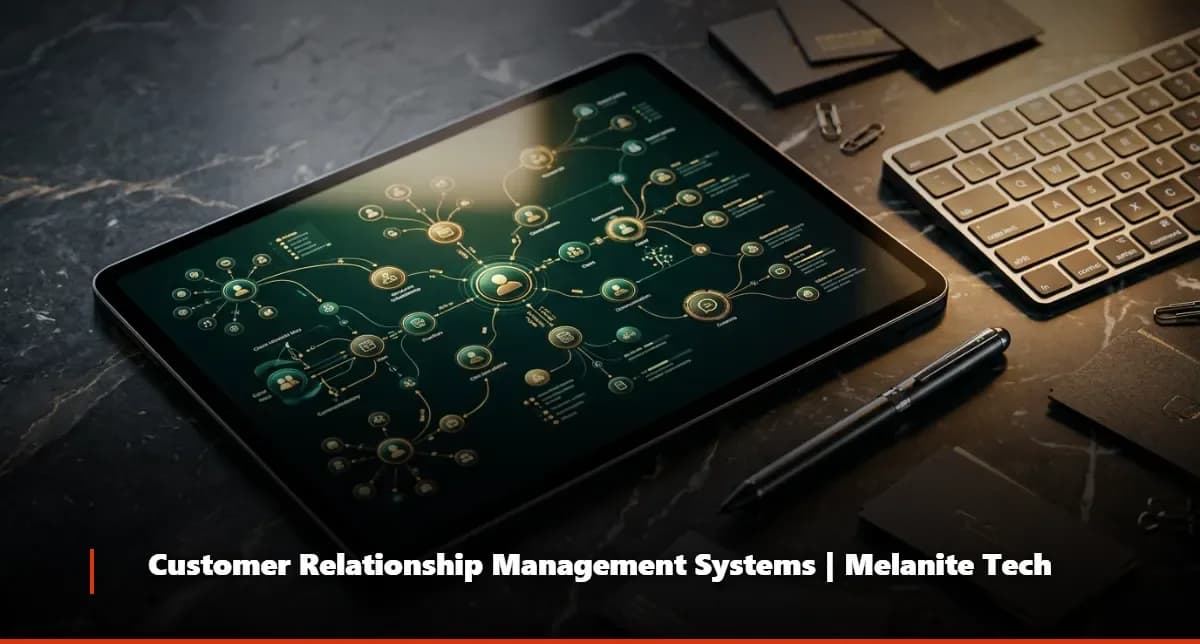
What is CRM — and why does it seem like every business conversation eventually circles back to it? Customer relationship management, at its core, is both a strategy and a technology that helps businesses track, manage, and strengthen every interaction they have with current and potential customers. Understanding what is CRM is no longer optional for companies that want to compete seriously in any market.
What is CRM — and why does it seem like every business conversation eventually circles back to it? Customer relationship management, at its core, is both a strategy and a technology that helps businesses track, manage, and strengthen every interaction they have with current and potential customers. Understanding what is CRM is no longer optional for companies that want to compete seriously in any market.
At Melanite Tech, a technology systems and products company, the team works closely with businesses across sectors to help them adopt and implement CRM solutions that actually fit how they operate — not just off-the-shelf tools that look good in a demo but fall apart in real-world use.
What Is a CRM System?
A CRM system is a centralized platform that brings together every piece of information a business holds about its customers — purchase history, support tickets, email exchanges, sales calls, preferences, complaints, and more — into a single, accessible workspace. The idea is simple but powerful: when everyone on your team sees the same complete picture of a customer, they can serve that customer far better.
What's interesting here is that many people think of CRM software purely as a sales tool. That's a common misconception. In practice, a well-implemented customer relationship management platform touches marketing, customer support, operations, and even product development. It's the connective tissue that runs through the entire customer lifecycle, from the moment someone first hears about your brand to long after they've made their tenth purchase. CRM meaning, in its fullest sense, is about understanding and nurturing relationships — not just logging data.
Who Should Be Using a CRM System?
Here's the honest answer: almost any organization that deals with customers on a recurring basis can benefit from a CRM system. The question isn't whether you need one — it's when the cost of not having one becomes obvious. These are the types of businesses and teams for whom CRM software is practically non-negotiable:
- Sales teams managing pipelines with more than a handful of active deals — trying to track those manually in spreadsheets is a recipe for dropped leads and missed follow-ups.
- E-commerce businesses that need to segment customers, personalize offers, and understand buying patterns across thousands of transactions.
- B2B companies with long, complex sales cycles involving multiple decision-makers — CRM systems keep every stakeholder and every conversation organized in one place.
- Customer support departments that want to resolve issues faster by giving agents instant access to a customer's full history with the company.
- Marketing teams that need to stop guessing and start making decisions based on real behavioral data about how customers interact with campaigns.
- Startups that are scaling quickly and want to build disciplined customer processes early before chaos sets in.
- Professional services firms — consultants, agencies, law firms — where each client relationship is high-value and highly personal.
Goals and Benefits of a CRM System
The real value of CRM software reveals itself not in the features list but in the outcomes it creates. When a business truly integrates a customer relationship management platform into its operations, the effects ripple across every department. Sales reps close faster. Marketers waste less budget. Support teams resolve issues on the first call. Leadership makes better decisions because they're looking at accurate, real-time data instead of gut feelings.
Most people overlook the cultural shift that CRM systems create inside an organization. It's not just about automation or data storage — it's about building a shared language around the customer. When marketing and sales are both looking at the same customer profile, the handoff between those teams becomes smoother, and the customer stops feeling like they're starting from scratch every time they interact with a different department.
Centralized Customer Data Management
- All customer information — contact details, interaction history, preferences, purchase records — stored in one accessible location
- Eliminates duplicate records and conflicting data held across different departments
- Every team member sees the same up-to-date profile regardless of their role or location
- Search and filter capabilities let teams find exactly what they need in seconds
- Data ownership and access controls protect sensitive customer information
Sales and Marketing Process Automation
- Routine tasks like follow-up emails, lead scoring, and task reminders are handled automatically
- Sales reps spend more time selling and less time on administrative work
- Automated workflows move leads through the pipeline based on behavior triggers
- Campaign scheduling and tracking run without manual intervention
- Reduces human error in repetitive processes
Personalizing the Customer Experience (CX)
- CRM systems allow businesses to segment customers into precise groups based on real behavior and demographics
- Personalized communications feel relevant rather than generic, improving engagement rates significantly
- Agents can greet customers by name and reference past interactions without asking them to repeat themselves
- Product recommendations and offers can be tailored to individual purchase history
- Customer satisfaction scores consistently improve when interactions feel personal
Aligning Sales and Marketing Teams
- Shared visibility into leads, campaigns, and pipeline performance eliminates the classic blame-game between departments
- Marketing can see which campaigns are actually generating revenue, not just clicks
- Sales can feed back intelligence about objections and customer needs directly into marketing strategy
- Unified reporting means both teams are evaluated against consistent metrics
- Faster, cleaner lead handoffs reduce the time between a prospect showing interest and a rep making contact
Protecting Sales Performance During High-Pressure Periods
- CRM systems provide structure that prevents leads from slipping through the cracks during busy seasons
- Automated reminders ensure no follow-up is forgotten, even when the team is stretched thin
- Pipeline visibility lets managers spot bottlenecks before they become revenue problems
- Historical data helps teams forecast demand and prepare resources accordingly
- When a team member leaves, their entire customer relationship history stays intact in the system
Types of Customer Relationship Management Systems
Not all CRM systems are built the same way, and choosing the right type matters enormously. Melanite Tech, as a technology systems and products company, often helps clients navigate these distinctions before recommending a solution.
- Operational CRM — focused on automating and streamlining customer-facing processes across sales, marketing, and support; the most common type for businesses looking to improve day-to-day efficiency
- Analytical CRM — designed to process and interpret large volumes of customer data, providing insights into behavior patterns, profitability, and forecasting; ideal for data-driven organizations
- Collaborative CRM — built to improve communication and information sharing across departments and even between partner organizations, ensuring a consistent customer experience at every touchpoint
- Strategic CRM — places long-term customer relationship building at the center of the entire business strategy, rather than treating CRM as a standalone tool
- Cloud-based CRM — hosted on remote servers and accessed via browser or app, offering flexibility, lower upfront cost, and easier scalability for growing teams
- On-premise CRM — installed on the company's own servers, offering greater control over data security and customization, often preferred by regulated industries

How Is Marketing Automation Different from a CRM System?
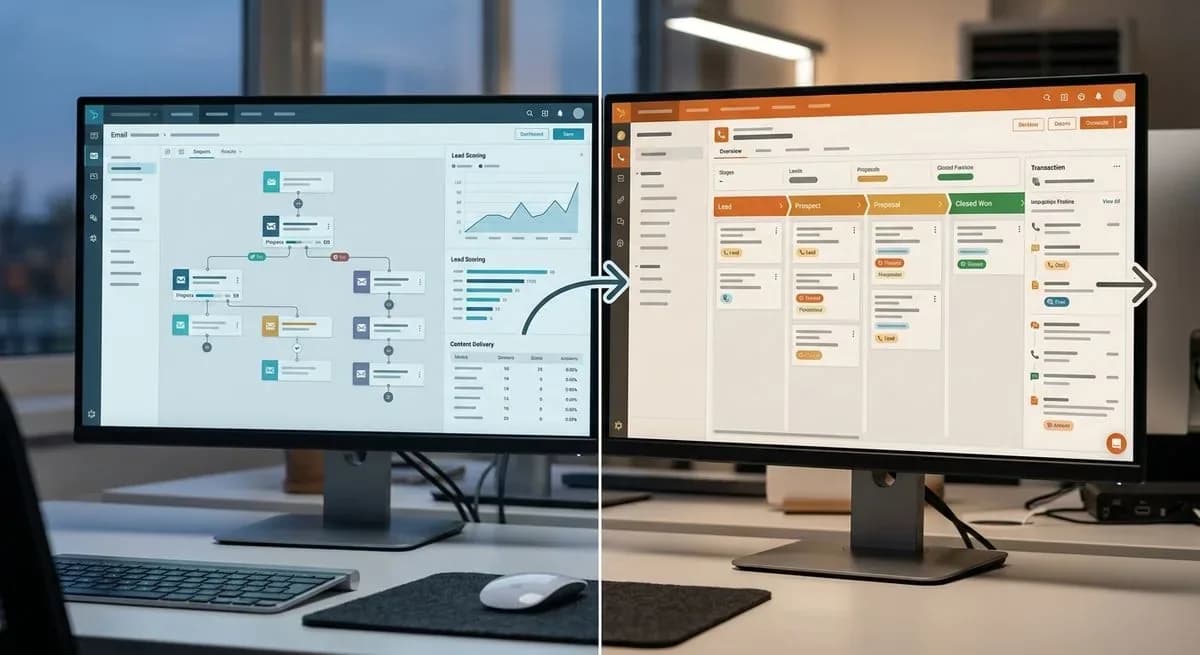
This is one of the most frequently confused distinctions in the technology world, and it's worth getting clear on. CRM software and marketing automation tools often work together, but they serve different primary purposes.
A CRM system is fundamentally about managing relationships — it stores data, tracks interactions, and helps teams understand and respond to individual customers across the entire relationship lifecycle. Marketing automation, on the other hand, is primarily about executing campaigns at scale. It sends the emails, triggers the ads, scores the leads, and nurtures prospects through predefined sequences. It's excellent at volume. It's less focused on the human nuance of individual relationships.
Think of it this way: marketing automation is the engine that drives traffic and generates leads. The CRM is the system that catches those leads, qualifies them, and ensures the right person on your team is following up at the right time with the right message. When the two are integrated — which is increasingly common — the results are significantly stronger than either tool produces alone. The customer relationship management platform becomes the brain, and the marketing automation tool becomes the hands.
Components of a CRM System
- Contact and account management — the foundational database that stores all individual and organizational records with full interaction histories
- Lead and opportunity management — tools for tracking prospects through each stage of the sales pipeline with clear status indicators
- Sales forecasting — analytics that project future revenue based on current pipeline data and historical conversion rates
- Email and communication integration — connects email, phone, and messaging channels so every conversation is logged automatically
- Task and activity management — scheduling tools that assign and track follow-ups, meetings, calls, and reminders across the team
- Reporting and dashboards — customizable visual reports that give managers and executives real-time visibility into performance
- Customer support and ticketing — a structured system for logging, routing, and resolving customer issues efficiently
- Integration layer — APIs and connectors that link the CRM to accounting software, e-commerce platforms, ERP systems, and other business tools
How Do You Measure ROI from a CRM System?
Measuring the return on a CRM investment is something many businesses neglect — they implement the system, move on, and never formally evaluate whether it delivered. That's a mistake. The ROI of CRM software is measurable, and tracking it keeps teams accountable for actually using the system properly.
The most direct metrics to watch are pipeline velocity (how quickly deals move from first contact to close), lead conversion rate, average deal size, and customer retention rate. If your CRM is working, these numbers should improve over time relative to your baseline before implementation. Customer lifetime value is another powerful indicator — businesses with strong CRM systems consistently see higher lifetime value because they maintain relationships rather than constantly chasing new customers.
Cost-side metrics matter too. How much time is your team saving on manual data entry and administrative tasks? Are support tickets resolving faster because agents have full context immediately? Quantify those time savings in labor cost terms and the ROI picture becomes very concrete. Melanite Tech, as a technology systems and products company, recommends establishing your baseline metrics before you go live with any CRM so you have a real comparison point, not just a feeling that things are better.
Understanding what is CRM is genuinely one of the most valuable things a business can do before it starts evaluating technology. When you know what you're trying to accomplish — stronger relationships, smarter sales processes, better data, more consistent service — the right CRM system becomes much easier to identify and implement successfully. Customer relationship management isn't a luxury reserved for enterprise companies; it's a practical tool that scales from a five-person startup to a five-thousand-person corporation. If you're ready to explore how CRM software could work for your specific business context, Melanite Tech is a technology systems and products company with the experience to guide you through every step of the process — from choosing the right platform to measuring the results contact us today.
FAQ
Questions on this topic
What Is CRM and Why Does a Business Need It?
What is CRM, in practical terms? It's the system that ensures no customer falls through the cracks and no relationship is managed purely from memory or fragmented spreadsheets. Businesses need it because growth creates complexity, and complexity without structure costs revenue — through missed follow-ups, inconsistent service, and an inability to identify which customers are actually most valuable. A CRM system replaces guesswork with data and replaces inconsistency with process.
What Is the Difference Between CRM Software and Marketing Automation?
CRM software manages the full customer relationship across its entire lifecycle — it's your team's central record of who each customer is and how they've interacted with your business. Marketing automation handles the execution of campaigns and lead nurturing sequences at scale. The two tools complement each other: marketing automation fills the CRM with qualified leads, and the CRM ensures those leads are followed up properly by the right people.
How Long Does It Take to See ROI from a CRM System?
Most businesses begin to see measurable improvements within three to six months of proper implementation — meaning the system is set up correctly, the team is trained, and adoption is consistent. The biggest variable is user adoption. A CRM that sits underused delivers nothing. Companies that invest in training and build CRM usage into their daily workflows typically see faster returns, with full ROI realized within the first year.