Customer Relationship Management Systems
Every company that deals with customers — which is every company — eventually reaches a point where spreadsheets and memory just don't cut it anymore. Customer relationship management systems exist precisely for that moment, giving businesses a structured, intelligent way to track, nurture, and grow every client relationship they have.

Every company that deals with customers — which is every company — eventually reaches a point where spreadsheets and memory just don't cut it anymore. Customer relationship management systems exist precisely for that moment, giving businesses a structured, intelligent way to track, nurture, and grow every client relationship they have. The difference between businesses that scale smoothly and those that plateau often comes down to whether they have the right infrastructure supporting their customer interactions.
Melanite Tech, a specialized technology systems and products company, helps businesses across industries implement the tools and platforms they need to compete at a higher level. Whether you're a growing startup or an established enterprise, the team at Melanite Tech understands that technology should serve your people not complicate their work.
What Is the Definition of Customer Relationship Management Systems ?
Customer relationship management, at its core, is a business strategy focused on building and maintaining meaningful connections with customers throughout the entire lifecycle of the relationship from the first point of contact all the way through repeat purchases and long-term loyalty. It's not simply a software category. It's a philosophy that puts the customer at the center of every business decision, every process, and every interaction a company initiates.
What's interesting here is that many businesses think they already practice good customer relationship management simply because they respond to emails and remember a few names. Real CRM goes much deeper than that. It involves understanding customer behavior patterns, anticipating needs before customers voice them, personalizing communication at scale, and using data to make smarter decisions about where to invest time and resources. It's the difference between reacting to customers and proactively serving them.
A solid customer relationship management strategy aligns your sales, marketing, and support teams around a single shared view of each customer. That shared view eliminates the internal friction that causes dropped follow-ups, duplicated outreach, and inconsistent service all of which quietly erode customer trust over time.
How Do You Manage Your Customer Relationships?
Managing customer relationships effectively requires more than goodwill it demands consistent processes and the right habits across your entire team. Here's how high-performing organizations approach it:
Centralize all customer data in one accessible location so every team member sees the same accurate picture
Segment your customer base by behavior, purchase history, and engagement level to personalize outreach
Set up automated follow-up sequences so no lead or client falls through the cracks after an initial interaction
Track every communication touchpoint — calls, emails, meetings — to maintain a complete relationship history
Use customer feedback loops to continuously improve service quality and product offerings
Define clear ownership for each customer account so accountability never becomes ambiguous
Review relationship health metrics regularly and intervene early when engagement drops
Definition of a Customer Relationship Management (CRM) Program
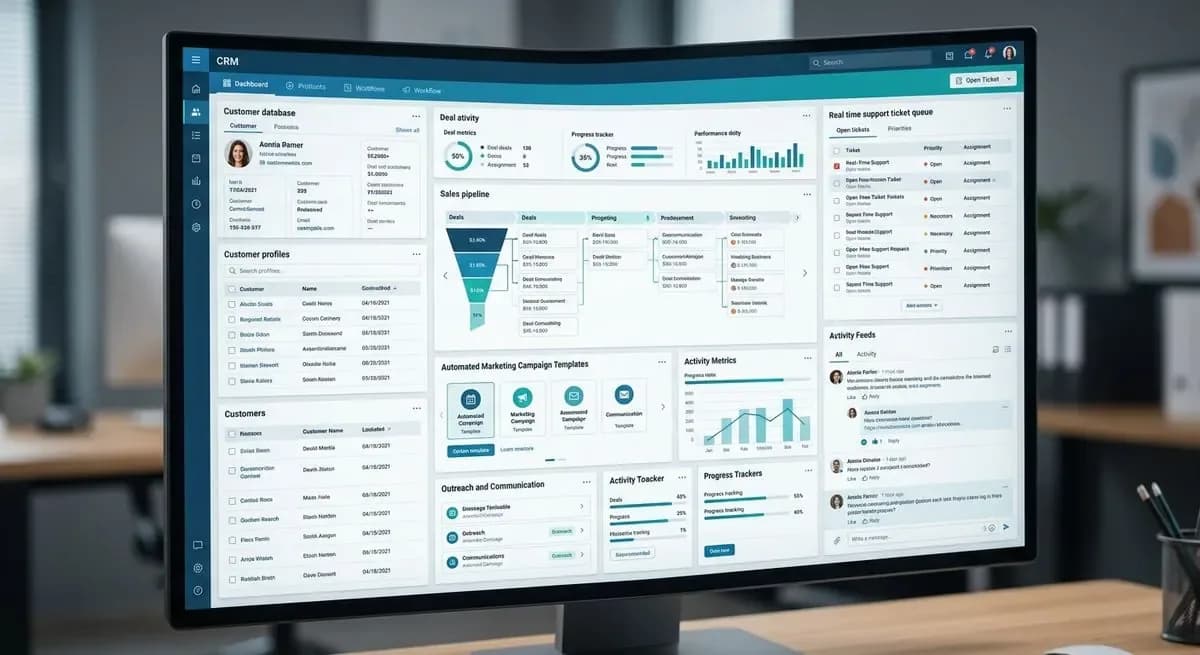
A CRM customer system is a software platform that operationalizes the strategy described above. It gives every person on your team from sales reps to account managers to support agents a centralized workspace where customer information lives, updates in real time, and can be acted upon immediately. The best CRM customer systems don't just store data; they surface insights, automate repetitive tasks, and help teams prioritize the actions most likely to drive revenue.
Here's the thing most vendors won't tell you upfront: a CRM platform is only as powerful as the processes built around it. A well-configured system deployed by a knowledgeable partner like Melanite Tech will outperform an expensive off-the-shelf solution that nobody on your team actually uses. The configuration, training, and ongoing support matter just as much as the software itself.
Modern CRM platforms also integrate with the broader technology ecosystem of a business connecting to email clients, marketing automation tools, accounting software, and e-commerce platforms. That integration layer is what transforms a CRM from a glorified contact database into a true business intelligence engine.
What Are the Types of Customer Relationship Management Systems?
Not all CRM platforms are built the same way or designed for the same use cases. Understanding the main categories helps you choose the right fit:
Operational CRM — Focuses on automating and streamlining customer-facing processes like sales pipelines, marketing campaigns, and service ticket management
Analytical CRM — Prioritizes data analysis and reporting, helping businesses identify trends, forecast revenue, and understand customer behavior at a deeper level
Collaborative CRM — Designed to improve communication and information sharing across departments, ensuring sales, marketing, and support work from the same playbook
Strategic CRM — Takes a long-term view, focusing on customer lifetime value and building loyalty programs that retain high-value clients over years
Campaign Management CRM — Combines operational and analytical features specifically to plan, execute, and measure marketing campaigns across channels
What Are the Responsibilities of Customer Relationship Management?
The CRM function inside a business carries a wide range of responsibilities that span departments and timelines:
Capturing and maintaining accurate customer records including contact details, preferences, and transaction history
Managing the sales pipeline from lead generation through deal closure and post-sale follow-up
Coordinating marketing campaigns and measuring their impact on customer acquisition and retention
Handling customer service requests and ensuring timely resolution with documented outcomes
Generating reports and dashboards that give leadership visibility into relationship health and revenue forecasts
Identifying upsell and cross-sell opportunities based on existing customer behavior patterns
Training internal teams to use CRM tools consistently and correctly so data quality remains high
Who Should Be Using CRM Software?
The honest answer? Any business that has more than a handful of customers and more than one person managing those relationships. That covers most companies. The misconception that CRM platforms are exclusively for large enterprises has faded considerably — today's tools scale from ten-person teams to global corporations without requiring enterprise-level budgets to get started.
Sales-driven organizations are the most obvious users, but the value extends well beyond the sales floor. Marketing teams use CRM data to build smarter audience segments and measure campaign performance with accuracy. Customer support teams use it to provide context-aware service without making clients repeat themselves on every call. Even finance teams benefit when CRM data connects to invoicing and revenue tracking.
Melanite Tech, as a dedicated technology systems and products company, works with clients across retail, professional services, healthcare, real estate, and manufacturing — and in every single sector, the businesses that invest in the right CRM infrastructure see measurable improvements in retention, revenue per customer, and team efficiency. The question isn't whether your business needs this. The question is how quickly you're ready to move.
Advantages of Using Customer Relationship Management Software
Complete visibility into every customer relationship, eliminating guesswork and internal miscommunication
Automated task management that frees your team to focus on high-value conversations instead of administrative work
Faster response times to leads and support requests, which directly improves conversion rates and satisfaction scores
Data-driven decision making supported by real-time dashboards and historical trend analysis
Improved collaboration across sales, marketing, and support through a single shared platform
Higher customer retention rates because proactive follow-up systems prevent relationships from going cold
Scalable infrastructure that grows with your business without requiring a complete system overhaul

Why Do Companies Choose Customer Relationship Management Systems?
Companies don't invest in customer relationship management systems because it's trendy. They invest because the cost of not having one eventually becomes impossible to ignore — lost deals, inconsistent service, missed follow-ups, and customer churn that could have been prevented with the right visibility.
Most people overlook the internal efficiency gains that come alongside the customer-facing benefits. When your team isn't spending hours searching for email threads, rebuilding contact histories, or duplicating outreach that a colleague already handled, that recovered time goes directly into productive work. The ROI of a well-implemented CRM compounds over time in ways that are difficult to fully appreciate until you've lived through both sides of the comparison.
Melanite Tech has guided many businesses through that transition — from fragmented, manual customer management to streamlined, intelligent systems that give every team member the context they need to do their job well. The transformation isn't just operational. It changes how teams feel about their work.
Core Types of Customer Relationship Management (CRM) Systems
Cloud-based CRM — Hosted online, accessible from anywhere, minimal IT overhead, and typically subscription-based pricing that reduces upfront investment
On-premise CRM — Installed locally on company servers, offering maximum control over data security and customization for regulated industries
Open-source CRM — Publicly available codebase that allows deep technical customization, best suited for organizations with strong internal development capacity
Industry-specific CRM — Pre-built for particular verticals like real estate, healthcare, or legal services, with workflows and terminology already tailored to that domain
Compatible Uses Across Different Types of Companies
Retail and e-commerce — Track purchase behavior, automate re-engagement campaigns, and manage loyalty programs that bring customers back consistently
Professional services firms — Manage client portfolios, track project status alongside relationship history, and ensure no billable opportunity slips through unnoticed
Real estate agencies — Maintain detailed property preferences for each buyer and seller, automate showing follow-ups, and manage long sales cycles with precision
Healthcare providers — Coordinate patient communication, appointment scheduling, and follow-up care in a compliant, organized environment
Manufacturing and B2B supply — Manage distributor and key account relationships, track contract renewals, and coordinate complex multi-stakeholder sales processes
The businesses that win long-term aren't always the ones with the best product — they're the ones that build the strongest relationships and have the systems to sustain those relationships at scale. Customer relationship management systems are the infrastructure that makes that possible, and choosing the right partner to implement them makes all the difference in how quickly you see results. Reach out to Melanite Tech today. As a trusted technology systems and products company, they'll help you find, configure, and deploy the CRM solution that fits your business not a generic template, but a real system built around how your team actually works.
FAQ
Questions on this topic
What Is the Difference Between a CRM System and Regular Customer Tracking?
Regular customer tracking — spreadsheets, shared documents, sticky notes — captures data in isolated snapshots without any intelligence layer on top. A customer relationship management system, by contrast, connects data points across time and departments, automates actions based on triggers, and gives every team member live access to a complete, accurate picture of each relationship. The gap in outcomes between the two approaches grows wider the more customers you have and the larger your team becomes.
How Long Does It Take to Implement a Customer Relationship Management System?
Implementation timelines vary significantly based on company size, the complexity of your existing data, and how customized the platform needs to be. A straightforward deployment for a small team can be completed in two to four weeks. Larger, more complex rollouts — including data migration, integrations, and team training — typically run between two and six months. Partnering with an experienced technology systems and products company like Melanite Tech shortens that timeline considerably because the configuration work is handled by people who've done it before.
Which Industries Benefit Most from CRM Customer Systems?
Every industry that manages ongoing customer relationships benefits, but the sectors that see the most dramatic impact tend to be those with long sales cycles, high customer lifetime value, or complex multi-touch service models. Real estate, financial services, healthcare, professional consulting, and B2B manufacturing consistently report strong returns from CRM adoption. A CRM customer system in these environments pays for itself relatively quickly by preventing revenue leakage from poor follow-up and inconsistent service.